

For years, brands competed for attention by posting more, advertising harder, and pushing constant notifications. Growth was measured by impressions, reach, screen time, and engagement rates. The assumption was simple. More exposure meant more impact.
In 2026, that assumption no longer holds.
A growing number of consumers are actively reducing their screen time, muting notifications, deleting apps, and stepping away from always-on digital life. This shift is not a rejection of technology. It is a response to digital overload. People are not going offline permanently, but they are becoming far more selective about how, when, and why they engage.
This behavior is known as digital detoxing. It is no longer a niche wellness trend. It is a mainstream behavioral shift that brands must understand and adapt to if they want to stay relevant in the years ahead.
Is your current marketing strategy noise or value? Let Hashtech optimize your brand for the digital detox generation with a personalized approach and AI‑driven insights.
Visit our Digital Marketing Solutions page now!
Understanding Digital Detoxing in 2026
Digital detoxing does not mean abandoning digital platforms altogether. Most people still use smartphones, social media, and apps daily. The difference is in how they use them.
In 2026, digital detoxing looks like intentional disengagement. People schedule no-screen hours. They turn off non-essential notifications. They limit social media usage to specific times. They unfollow brands that feel noisy or intrusive. They prioritize platforms that feel useful, calming, or respectful of their time.
This shift is driven by awareness. Consumers understand how algorithms work. They know platforms are designed to maximize time spent. As a result, many people are pushing back to regain control.
For brands, this means fewer opportunities to interrupt and more pressure to earn attention.
| Average daily social media use is projected to drop significantly, and global users are spending less time online as digital detox behaviors grow, with screen time decreasing by nearly 28% from 2023–2025. |
Why Digital Detoxing is Accelerating Now
Now you know the digital detox meaning.
It’s time to understand the several factors that have converged to accelerate digital detoxing in recent years.
First, screen fatigue is real. Remote work, online education, streaming entertainment, and social media have blurred boundaries between work and personal life. Many people feel mentally exhausted by constant digital input.
Second, mental health awareness has increased. Studies and conversations around anxiety, burnout, and attention disorders have made consumers more conscious of their digital habits. Reducing screen time is seen as a form of self-care.
Third, platform saturation has reached its limit. Feeds are crowded. Ads look similar. Notifications compete aggressively. When everything demands attention, people tune out.
Finally, technology itself has enabled detoxing. Devices now include screen time tracking, focus modes, and notification controls. Detoxing is easier to implement and normalize.
This combination has changed consumer behavior in a lasting way.
The Myth That Digital Detoxing Hurts Brands
Some marketers view digital detoxing as a threat. Less screen time means fewer impressions. Fewer notifications mean lower open rates. From this perspective, detoxing looks like a loss.
In reality, digital detoxing does not eliminate opportunity. It filters it.
Consumers who detox are not disengaged. They are selective. When they choose to engage, they are more focused and intentional. This creates higher quality attention, even if the volume is lower.
For brands, the challenge is not visibility. It is relevance.
How Consumer Behavior Is Changing
To understand what digital detoxing means for brands, it is important to understand how consumer behavior has shifted.
People are checking content less frequently, but with more purpose. They prefer fewer platforms and fewer brands. They expect value immediately. They disengage quickly from content that feels repetitive or self-serving.
Passive scrolling is declining. Active consumption is rising. This means consumers are more likely to save content, revisit it, or act on it if it is genuinely useful.
This shift favors brands that prioritize clarity, usefulness, and trust over volume and hype.
What Digital Detoxing Means for Content Strategy
In a detoxing world, content strategy must change fundamentally.
More content is not better. Better content is better.
Brands must focus on depth rather than frequency. Long-form content that educates, explains, or solves real problems performs better than shallow posts designed for quick engagement.
Consumers want content that respects their time. This means clear headlines, straightforward messaging, and immediate value. Clickbait fails faster than ever because people are unwilling to waste attention.
Consistency still matters, but consistency in quality matters more than consistency in posting.
| Younger users (ages 18–24) have seen digital detox participation more than double between 2023 and 2025, making Gen Z a key driver of intentional tech use. |
Advantages and Disadvantages of Digital Detox
While digital detoxing is increasingly popular, it comes with both benefits and trade-offs for individuals and brands alike.
Advantages
- Improved focus and mental clarity: Reduced screen time allows users to concentrate on tasks without constant digital interruptions.
- Better mental health: Less exposure to notifications, social comparison, and information overload can lower stress and anxiety.
- Intentional engagement: Consumers become more selective about what content they consume, which can lead to higher-quality interactions with brands.
- Strengthened offline relationships: More time is spent connecting with people in real life rather than through screens.
Disadvantages
- Temporary disengagement: Brands may experience lower reach or engagement when audiences are actively detoxing.
- Missed opportunities for spontaneous interaction: Consumers may skip campaigns or offers that rely on impulse engagement.
- Adjustment period: Both brands and users may need time to adapt to new habits, such as less frequent notifications or email communications.
- Potential feelings of missing out: Individuals may initially feel disconnected from trends, news, or social updates.
By understanding the advantages and disadvantages of digital detox, brands can better adjust their strategies to respect consumer’s time while still maintaining meaningful engagement.
The Decline of Interruptive Marketing
Digital detoxing is accelerating the decline of interruptive marketing. People are increasingly ignoring or actively blocking pop-ups, aggressive retargeting, autoplay videos, and excessive notifications.
Consumers are using ad blockers more frequently. They unsubscribe from email lists quickly. They mute brands on social platforms without hesitation.
This does not mean advertising is dead. It means advertising must be contextual, respectful, and well-timed.
Brands that rely on interruption will see diminishing returns. Brands that integrate naturally into the consumer journey will stand out.
Permission-Based Engagement Is Becoming Essential
One of the biggest implications of digital detoxing is the importance of permission.
Consumers want control. They want to choose when they hear from a brand and how often. Brands that respect this build trust. Brands that ignore it lose relevance.
Email newsletters that deliver genuine value are thriving, even as inbox fatigue grows. Communities built around shared interests outperform broad social followings. Podcasts succeed because listeners opt in intentionally.
Permission based engagement creates stronger relationships and higher lifetime value.
The Rise of Quiet Brands
In 2026, some of the strongest brands are not the loudest ones.
Quiet brands focus on clarity, reliability, and usefulness. They communicate less frequently but more meaningfully. They do not chase every trend or platform.
These brands build trust by being consistent and predictable. When they speak, people listen because the message matters.
Digital detoxing rewards brands that know when to stay silent
| Glossier’s “Screen Break” wellness-led messaging saw 41% higher engagement with Gen Z audiences by integrating digital well-being into its content strategy. |
How Brand Metrics Need to Evolve
Traditional metrics like impressions, reach, and engagement rate do not fully capture success in a detoxing environment.
Brands need to focus on metrics that reflect real impact. Time spent on meaningful content. Return visits. Saves and shares. Email replies. Community participation. Conversion quality.
Lower traffic does not necessarily mean weaker performance. In many cases, it means higher intent.
Brands that optimize for quality signals will outperform those chasing volume.
What This Means for Social Media Strategy
Social media is not disappearing, but its role is changing.
In 2026, social platforms function more as discovery and validation tools rather than constant engagement channels. Consumers dip in, check updates, and leave.
Brands should treat social media as an entry point, not the destination. Content should guide interested users toward owned platforms like websites, newsletters, or communities where deeper engagement can happen.
Posting less often but with stronger intent improves visibility and trust.
Email is Gaining Strategic Importance
Email may seem old compared to social media, but digital detoxing has increased its value.
Email allows controlled, intentional communication. Subscribers choose to receive messages. Brands can set clear expectations around frequency and content.
Well written, well timed emails that educate or help rather than sell aggressively perform extremely well in a detoxing environment.
Email is not about volume. It is about relevance.
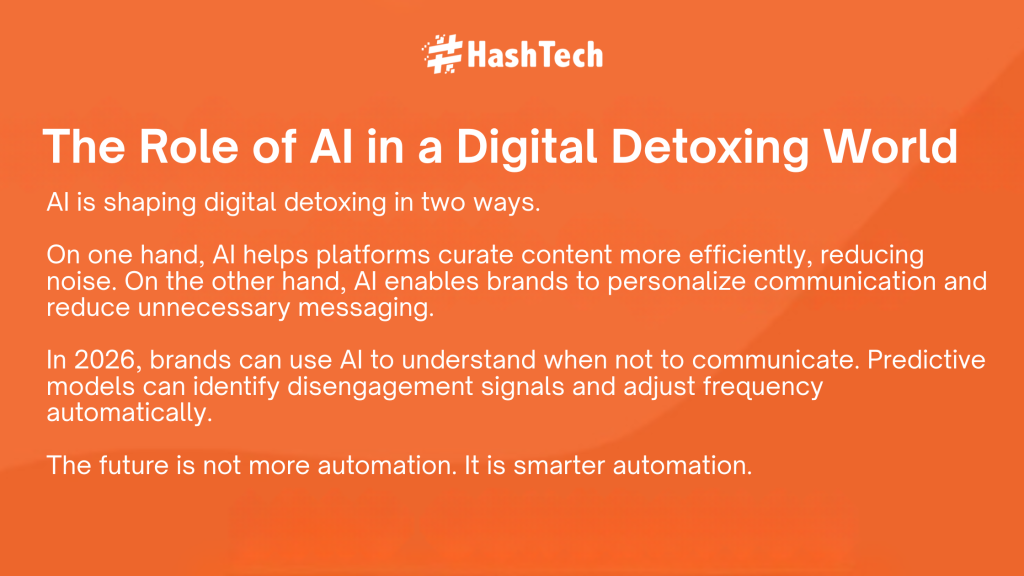
Digital Detoxing and Trust
Trust is the currency of the detoxing era.
When consumers disengage from noise, they gravitate toward brands they trust. Trust is built through transparency, consistency, and respect.
Brands that over-message, mislead, or prioritize short-term gains lose trust quickly. Once trust is lost, re-engagement is difficult.
Every interaction matters more because there are fewer of them.
Industries Most Affected by Digital Detoxing
Some industries feel the impact of digital detoxing more strongly.
Lifestyle, wellness, finance, education, and B2B services are seeing increased demand for thoughtful, long-form content. Entertainment and fast fashion are adjusting to reduced impulse consumption.
SaaS and professional services benefit from higher intent engagement. Retail brands must work harder to justify attention.
Understanding industry-specific behavior is critical.
| Outdoor Voices ran a campaign designed to minimize attention extraction while maximizing meaningful engagement, resulting in significantly higher quality interactions despite fewer total impressions. |
How Brands Should Adapt Their Strategy in 2026
Brands that succeed in a detoxing environment follow a few clear principles.
They communicate with purpose. They reduce unnecessary messaging. They focus on owned channels. They invest in content that ages well. They listen more than they broadcast.
They also test and measure continuously. Detoxing behavior is not static. It evolves with culture, technology, and life patterns.
Adaptation is ongoing, not a one-time adjustment.
The Long-Term Outlook for Digital Detoxing
Digital detoxing is not a temporary trend. It reflects a broader cultural shift toward intentional living.
Technology will continue to evolve. AI, wearables, and immersive platforms will introduce new challenges and opportunities. But the desire for balance will remain.
Brands that align with this mindset will stay relevant. Brands that fight it will struggle.
Final Thoughts:
The trend of digital detoxing is forcing brands to rethink what attention really means. In 2026 and beyond, attention is not something you take. It is something you earn.
Consumers are not rejecting brands. They are rejecting noise.
Brands that deliver clarity, usefulness, and respect will thrive in this new environment. Those that rely on volume, interruption, and pressure will fade into the background.
Digital detoxing is not the end of digital marketing. It is the evolution of it. Partner with Hashtech to build intentional, high‑impact marketing that earns attention, not interrupts it.