

For years, the marketing funnel was treated as a law of nature. Awareness at the top, consideration in the middle, conversion at the bottom. Every campaign, landing page, and dashboard was built around pushing people downward, step by step.
But in 2026, this way of thinking is no longer aligned with how people actually behave.
Modern customers do not move neatly from one stage to another. They jump. They pause. They disappear. They reappear months later. They research without intent. They compare without urgency. They make decisions quietly, often long after the first interaction.
This is not a temporary shift. It is a permanent change driven by AI discovery, social validation, content overload, and empowered buyers. Brands that still rely on old funnel logic are not failing because their execution is poor. They are failing because the model itself is outdated.
To grow in 2026, you must stop forcing customers through funnels and start designing strategies that match how people truly think, decide, and trust.
Stop forcing outdated funnels. Partner with Hashtech to design AI-optimized, trust-driven marketing strategies that match how modern customers think, start growing in 2026 today!
Why the Traditional Funnel Is Breaking
The classic funnel assumes that customers start with little to no awareness and gradually become more informed as brands guide them forward. In reality, modern customers are already informed before they ever engage with you.
By the time someone lands on your website in 2026, they have likely:
- Seen your brand name multiple times
- Read reviews or comments
- Compared you with competitors
- Asked an AI tool about your credibility
Awareness is no longer a starting point. It is ambient. Customers live in a constant state of exposure, and decisions form long before any official campaign touches them.
The funnel also assumes forward motion. But modern buyers move backward and sideways. They revisit old content, re-watch videos, and re-evaluate decisions after new information appears. The funnel cannot capture this behavior, which is why so many campaigns feel disconnected from real results.
How Modern Customers Actually Think in 2026
Non-Linear Decision Paths
Customers no longer follow a sequence. They may jump straight to pricing before understanding your offer, then go back to educational content later. Some trust you before they fully understand what you sell. Others understand the product but delay trust for months.
Decision-making happens in loops, not lines.
This is largely driven by constant access to information. With AI search, social platforms, and peer reviews available instantly, customers can validate or dismiss brands at any point in the journey.
Trust Comes Before Tactics
In 2026, trust is the real currency. Customers are highly resistant to persuasion tactics, but deeply responsive to credibility signals. They look for consistency across platforms, clarity in messaging, and confirmation from others.
They trust:
- Repeated brand mentions
- Clear educational content
- Transparent positioning
- Consistent answers
If trust is missing, no amount of funnel optimization will fix it.
The Always-On Buyer Mindset
Modern customers are never fully “out” of the market. Even when they are not actively buying, they are observing. They save posts, bookmark pages, follow brands, and mentally shortlist options.
Buying is not a moment, it is a slow accumulation of confidence.
Why the Funnel Fails in the Real World
Funnels fail because they reduce people to stages.
A real customer can be:
- High awareness and low trust
- High trust and low urgency
- High intent but high fear
- Ready to buy but waiting for confirmation
Funnels cannot account for these combinations. They force customers into boxes that don’t reflect reality.
Funnels also prioritize conversion above experience. They optimize for short-term action while ignoring what happens after the sale. In 2026, post-purchase experience, clarity, and support are critical because customers publicly share their experiences, influencing future buyers.
A model that ignores continuity cannot survive in a connected world.
Don’t let misleading tactics or hidden traps cost your brand. Discover the dark side of digital marketing and how to protect your business. Read more.
The New Customer Journey Model for 2026
From Funnel to Loop
Instead of a funnel, think of a loop:
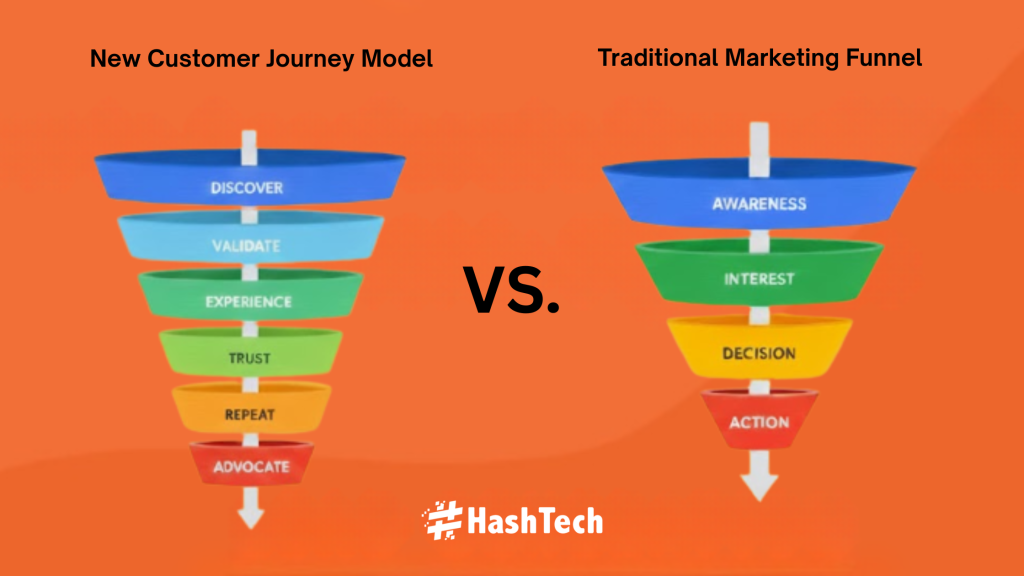
Discover → Validate → Experience → Trust → Repeat → Advocate
Customers can enter this loop at any point and exit temporarily at any time. The goal is not to force movement, but to remain present and helpful wherever they are.
Micro-Moments Replace Stages
In 2026, decisions are influenced by micro-moments:
- A scroll that sparks curiosity
- A search that confirms credibility
- A comment that builds trust
- A saved post that delays action
Brands that win are those that show up clearly and consistently during these moments.
New Strategies Brands Must Follow in 2026
Build Presence, Not Campaigns
Campaigns are temporary. Presence is continuous.
Modern brands focus on always-on visibility rather than short-term spikes. This means creating content ecosystems, blogs, videos, FAQs, social posts that compound over time. When customers encounter your brand repeatedly with the same clear message, trust accelerates.
Design for Re-Entry
Many customers leave before converting. That does not mean they are lost.
Your content should welcome people back. This includes posts that speak to hesitation, FAQs that answer lingering doubts, and messaging that reassures rather than pressures. In 2026, brands that respect indecision will outperform those that push urgency too early.
Authority Comes Before Persuasion
Persuasion without authority fails quickly. Customers want to understand before they commit.
Educational content, transparent explanations, and clear answers position your brand as a guide rather than a seller. This is especially important in AI-driven discovery, where clarity and structure increase citation potential.
Community-Driven Growth
Customers trust conversations more than campaigns. Comments, discussions, groups, and user-generated content all act as validation layers.
Brands that encourage participation, not just consumption, build deeper loyalty and longer customer lifecycles.
AI-Optimized Touchpoints
AI plays a growing role in how customers discover and validate brands. Structured content, direct answers, and FAQ-based formats help AI systems understand and surface your brand.
This is no longer optional. If AI cannot clearly explain what you do and why you matter, you lose visibility.
FAQs
Why doesn’t the traditional marketing funnel work anymore?
The traditional funnel assumes linear behavior, but modern customers move non-linearly. They research, compare, pause, and revisit across platforms. This makes funnel-based strategies misaligned with real decision-making in 2026.
What replaces the funnel in 2026?
The funnel is replaced by a loop-based journey focused on discovery, validation, experience, trust, and repetition. Customers enter and exit freely, and brands succeed by staying visible and helpful throughout.
How do modern customers make buying decisions?
Modern customers rely on repeated exposure, social proof, clear education, and AI-driven validation. Decisions form gradually through micro-moments rather than a single persuasive interaction.
Is conversion still important in 2026?
Yes, but conversion is a result not the focus. Brands that prioritize trust, clarity, and experience convert more consistently over time than those obsessed with immediate action.
How should brands structure marketing in 2026?
Brands should build always-on content ecosystems, focus on authority and education, design for re-entry, and optimize content for AI discovery and customer validation.
Does this modern marketing funnel approach work for small businesses?
Absolutely. Small businesses often benefit the most because trust, clarity, and consistency can outperform large ad budgets when executed well.
How does AI change customer journeys?
AI accelerates validation. Customers use AI to compare options, verify credibility, and summarize opinions. Brands with structured, clear, and authoritative content gain an advantage in these AI-mediated decisions.
Conclusion
The biggest mistake brands can make in 2026 is assuming customers still think in linear funnels. They don’t. Modern buyers move fluidly, validate brands before intent forms, and revisit decisions multiple times guided by content, conversations, and AI-driven insights.
The old funnel fails because it tries to control a journey that no longer belongs to brands. The new approach accepts reality: customers are in charge, and trust is built gradually through consistent presence, clear messaging, and meaningful engagement.
Brands that succeed will design for re-entry, optimize content for AI discovery, and support customer decisions instead of forcing them. That’s where Hashtech comes in.
At Hashtech, we assist businesses in creating always-on marketing strategies, structured content, and AI-optimized touchpoints that align with the way modern customers think.
We ensure your brand is visible, credible, and ready to convert in 2026 and beyond.
Stop pushing customers through outdated funnels. Let Hashtech guide your brand into the future of marketing, where trust, clarity, and smart strategy win every time.