

A company’s online visibility depends on search engine optimization (SEO), which remains essential despite the evolving nature of search. While many still view SEO as simply the process of driving keywords and backlinks, 2025 brings deeper shifts: AI-driven search, voice and visual interaction, user experience priorities, and new ranking frameworks.
By understanding how SEO has evolved, what success looks like today, and how technology is reshaping visibility, you’ll be better positioned to adapt, whether you’re a business owner, marketer, or content creator.
SEO isn’t what it used to be and neither are we. At Hashtech, we combine human creativity with AI precision to help you dominate organic search results and drive real business growth. Explore Our SEO Solutions.
What Is Search Engine Optimization (SEO) in 2025?
Search Engine Optimization (SEO) is the practice of improving a website’s ability to be found, understood, and rewarded by search engines so that it attracts relevant traffic from search queries. In 2025, that definition remains true, but the strategies and mechanisms have transformed. Instead of just targeting keywords and links, modern SEO emphasizes user intent, machine-readable context, authoritativeness, and cross-platform visibility.
| In 2025, SEO is about being the best answer in a world where search engines are increasingly powered by AI and where users expect immediate, helpful responses. |
How Search Has Evolved (2015-2025)
Over the last decade, SEO moved from keyword stuffing and mass link building to mobile-first indexing, semantic search, and user-experience signals.
- Mobile-first indexing is now mandatory; for example, the 2025 statistic shows mobile usage delivers over 92% of global web access.
- In 2023–24, Google rolled out major algorithm updates (such as the “March 2025” update impacting ~53% of indexed domains).
- Generative AI in search has emerged: Google Search Generative Experience (SGE) is live in 120+ countries.
These changes mean search engines now evaluate content not just for keywords but also for context, responsiveness, device performance, and user behavior.
Core Pillars of Modern SEO in 2025
Make image for this content; just take the headings.
EXAMPLE:
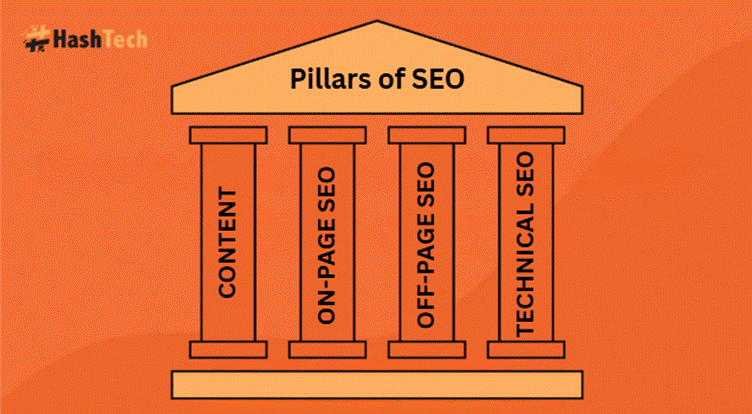
To succeed in 2025, SEO is no longer about manipulating algorithms, it’s about building credibility, usability, and relevance that both humans and AI-driven search systems recognize. A strong SEO strategy stands on five core pillars, each working together to shape visibility, trust, and performance.
Technical SEO: This includes site-speed, Core Web Vitals, structured data, mobile/desktop parity and indexation hygiene. Google’s mobile-first and performance standards leave no room for neglect.
On-Page SEO: Modern on-page SEO goes beyond keyword placement. It’s about semantic optimization, Natural Language Processing (NLP) alignment, and user-first clarity. Search engines in 2025 analyze context, tone, and intent to match queries with precise, human-readable content. This means optimizing headers, meta tags, and internal linking, but also ensuring your text is AI-readable and contextually rich.
Content SEO: Content must match search intent, show expertise, authority and trustworthiness (often referred to as E-E-A-T) and provide real value. One 2025 report shows intent-driven content accounts for 23 % of Google’s ranking algorithm.
Off-Page SEO: Links still matter, but also brand mentions, earned media, digital PR and trust signals from authoritative sites. Link-building is evolving rather than disappearing.
SEO Trends Dominating 2025
Several trends are reshaping SEO in 2025:
- Search Generative Experience (SGE) and AI-powered results: Google’s SGE feature now appears in many queries and influences click behaviour.
- Voice & Visual Search: Voice queries are growing; one report says voice search accounted for ~21.7% of Google queries in 2025.
- Entity-based & Semantic Search: Search engines increasingly understand relationships between concepts, not just keywords.
- Personalised and Conversational Search: Queries are longer, more conversational; one finding shows generative search queries average ~23 words vs ~4 for classic search.
- Human + AI Collaboration: Content creation isn’t solely human or machine; the best results are created by humans using AI for insight, speed and scale.
These shifts mean businesses must rethink how they craft content, structure sites and build visibility.
The Role of AI and Automation in SEO
AI and automation are no longer optional, they’re foundational.
- A 2025 study reports that websites using AI for content optimisation saw up to a 70% increase in organic traffic.
- AI tools reduce keyword research time by up to 80% and increase content optimisation efficiency by 30%.
That said, ethical use matters: search engines favour original, user-focused content over spammy or automated mass generation. Balance automation with human creativity, editorial oversight and genuine expertise.
Don’t let your competitors outrank you in the age of AI search. Partner with Hashtech, where strategy meets innovation from keyword intelligence to voice and visual search optimization.
Future-Focused SEO Strategies for 2025
To stay ahead, consider these strategic moves:
- Build Topical Authority: Instead of chasing many keywords, focus deeply on one subject so search engines view your site as an expert hub.
- Prioritise First-Hand Experience: Google’s E-E-A-T framework emphasises real experience, not just theoretical knowledge.
- Create Brand-Driven SEO Ecosystems: Combine content, PR, community and brand signalling to build visibility beyond keywords.
- Optimise for Voice, Visual & Conversational Search: Write content like natural dialogue, include transcriptions for video/audio and fine-tune images with alt text and metadata.
- Adapt to Generative Search Dynamics: Since AI can surface answers directly, rethink how your content fits into “answer” formats, trusted citations and conversational interfaces.
Common SEO Mistakes to Avoid in 2025
Even in 2025, many websites still fall into classic SEO traps from ignoring AI-driven search behavior to over-optimizing keywords and neglecting user intent. This section highlights the most common SEO mistakes to avoid so your strategy stays future-ready, compliant, and competitive in the evolving search landscape.
- Over-optimising AI-generated content: Purely machine-written text lacking human insight risks being ignored by search engines.
- Ignoring structured data and schema markup: Without it, your content may be invisible to advanced search interfaces.
- Focusing solely on Google ignoring other platforms: YouTube, TikTok, voice assistants and AI search are all search engines in their own right.
- Neglecting user experience and accessibility: Slow sites, poor navigation and mobile glitches hurt search performance and user perception.
Tools & Tech Stack for SEO in 2025
Key tools and platforms you should know:
- AI-powered SEO suites (e.g., SurferSEO, Ahrefs, Clearscope) that assist in content briefs, topic clustering and optimisation.
- Analytics platforms that track query behaviour, entity presence and zero-click traffic.
- Automation tools for workflow integration: content audits, link monitoring and performance tracking.
As a 2025 TechRadar report noted, the best SEO tools now combine usability, AI-integration and scalability.
Measuring SEO Success in 2025
Traditional KPIs like keyword rank still matter, but the most relevant metrics now include:
- Engagement metrics (dwell time, bounce rate, scroll depth)
- Zero-click visibility (how many users find answers without clicking through)
- Entity and schema presence (how your content is understood by machines)
- Traffic from voice/visual searches and AI-powered platforms
A report shows that while top organic listing CTR remains ~27.4% for page one in 2025, traditional rank alone no longer guarantees traffic.
Future of SEO: Where It’s Headed Beyond 2025
The future of SEO goes far beyond keywords and backlinks. As search engines evolve toward AI-driven personalization and multimodal search, optimization will center on intent, context, and trust. Beyond 2025, SEO will merge with user experience, voice and visual discovery, and real-time AI summaries, rewarding brands that combine technical precision with genuine human value.
- AR/VR and immersive search experiences will start to matter.
- Conversational assistants may replace traditional search bars entirely.
- Brand credibility, real-world experience, and community engagement will become dominant ranking signals.
- Search will become more integrated across devices, contexts, and modalities.
Prepare now by investing in a strong brand, content ecosystem, and user-first design.
Anchor: Want a sneak peek of your brand’s AI-powered glow-up? Let Hashtech show you how your SEO can skyrocket and make your brand totally unmissable in 2025. Contact Us & See the Magic.
Key Takeaways
- SEO in 2025 is not just about keywords and links; it’s about intent, context, experience, and machine readability.
- AI and automation have become embedded in SEO practice, but human insight remains irreplaceable.
- Multi-modal queries (voice, image, conversation) demand new optimization strategies.
- Topical authority, brand presence, and user experience matter more than ever.
- Avoid outdated tactics like keyword stuffing or ignoring structured data, and imagine searching evolving beyond the search bar.
| Disclaimer: This article is for informational purposes only and does not constitute financial or marketing advice. Always consult qualified SEO professionals or digital marketing experts before making foundational strategy decisions regarding your business’s visibility, content or search optimization. |